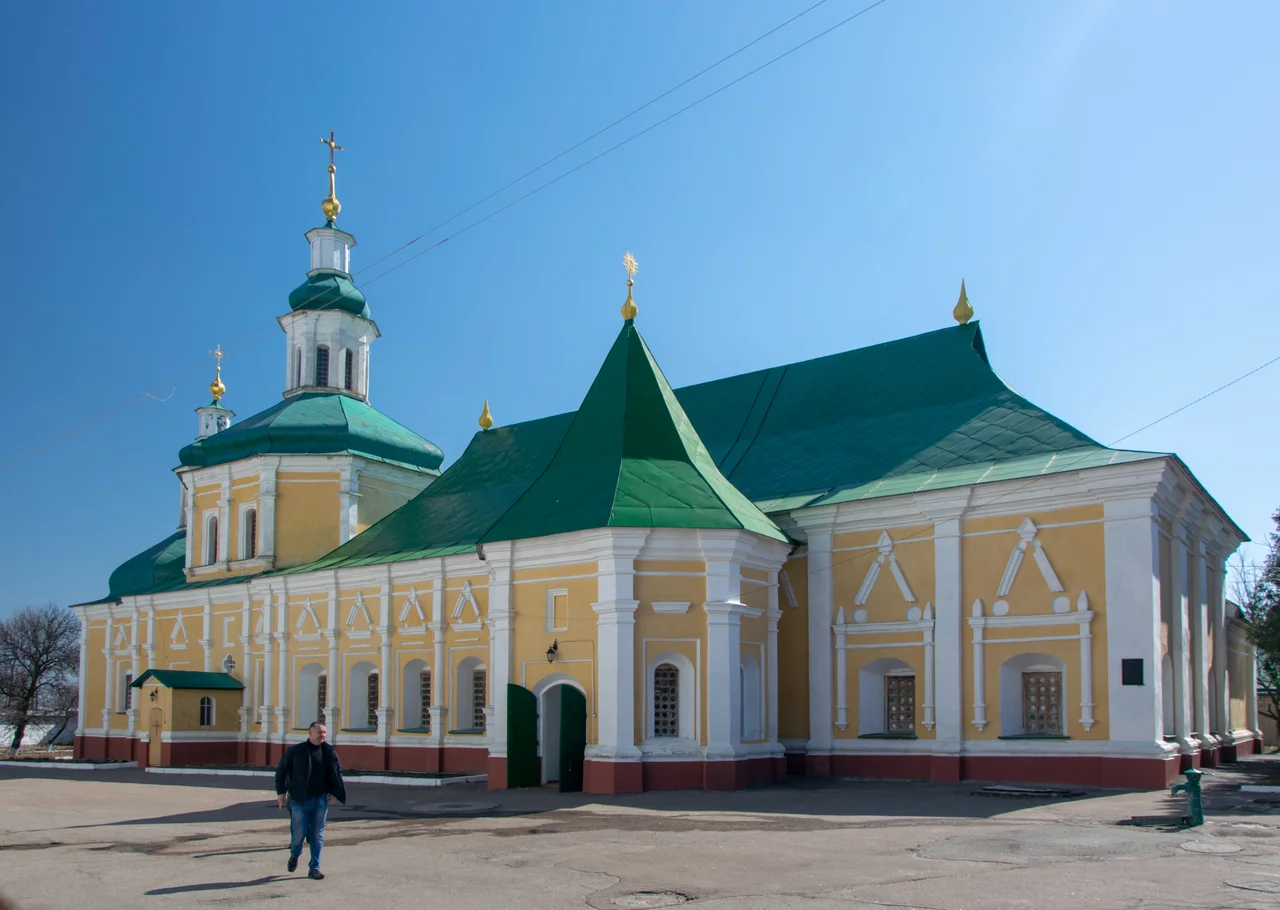

Trinity Monastery, Chernihiv
Long before it was a monument to survey from the air, the Trinity Monastery was a place that made books. In an age when a printing press was a rare and powerful thing, this hilltop cloister in Chernihiv housed one that turned out engravings admired across the land, and it guarded a library of more than eleven thousand volumes. The seven pear-shaped domes of its great cathedral still ride the skyline of northeastern Ukraine, one of the finest flowerings of Baroque this country produced. But the deeper story here is of a house built for the printed word.
A New House on Old Ground
The Trinity Monastery is the second act of a much older story. The original cloister of St. Elijah on the Boldyni Hory traced its founding to Saint Anthony of Pechersk in the eleventh century, but the Mongol invasion of 1239 emptied it, and by the fourteenth century it had crumbled, its passages filled in, with only one tiny church surviving. Then, in 1649, Bishop Lazar Baranovych founded a new monastery nearby, and the site was reborn. Through the seventeenth century it became the seat of the Chernihiv archbishops, a center of church power and learning perched above the city. The land had held sacred buildings for six hundred years; now it would hold a new one, grander than anything that came before.
The Printing House on the Hill
Baranovych's greatest gift to the monastery was not stone but ink. He had established a printing press in the nearby town of Novhorod-Siverskyi, an uncommon prize in that era, and in 1679 he transferred it here to the Trinity Monastery. The press became famous for its engravings, intricate printed images that carried the artistry of Ukrainian Baroque onto the page and out into the world. Alongside it grew a library renowned for holding more than eleven thousand books, an extraordinary trove for the time. In an age when knowledge moved slowly and books were treasures, this hilltop cloister was a powerhouse of culture, printing and preserving the words that shaped a region's faith and imagination.
Seven Domes of the Baroque
The monastery's crowning glory rose between 1679 and 1695. The great cathedral, or katholikon, was built to designs by Johann Baptist Sauer, a master builder from Wilno, funded by the Chernihiv colonel Vasyl Dunin-Borkovsky and realized with the patronage of Hetman Ivan Mazepa, whose name is bound up with the golden age of Ukrainian Baroque architecture. Crowned with seven pear-shaped cupolas, the Holy Trinity Cathedral is considered a high point of the style. Around it the ensemble filled out with the Vvedenska refectory church, completed by 1679, and a bell tower raised in 1775. Together they form one of the most striking Baroque compositions in Ukraine, all soaring domes and white walls catching the light above the Desna.
Closures and Returns
The monastery's fortunes rose and fell with the powers that ruled it. In 1786 it was closed and turned into a bishop's residence, and the cathedral was heavily rebuilt, stripped of four of its domes and much of its Baroque detail. Under Soviet rule the religious center was liquidated altogether, though a nunnery briefly operated on the grounds from 1942 until 1962. The graceful form visitors see today is largely the work of a reconstruction campaign in the 1980s, which restored much of what earlier centuries had taken away. Since 1991 it has once more served as the seat of a local bishopric. Near the cathedral rests the fabulist Leonid Glibov, and just beyond, on the Boldyni Hory, lies the writer Mykhailo Kotsiubynsky, keeping the hill's long tradition of holding its dead among the domes.
From the Air
The Trinity Monastery stands at 51.48 N, 31.28 E on the Boldyni Hory heights above the Desna in Chernihiv. View from 4,000 to 7,000 feet in clear weather; the seven-domed Holy Trinity Cathedral and the tall 1775 bell tower are the dominant landmarks, visible for miles across the river plain. Nearest airport is Chernihiv Shestovytsia (UKRR); Kyiv Boryspil (UKBB) lies to the southwest.
Nearby Stories
- Nizhyn 20 km away
- Principality of Chernigov 27 km away
- Oster 28 km away
- Battle of Listven 28 km away
- Battle of Chornobyl 30 km away
- Mezhyhirya Residence 60 km away
- Mezine 100 km away
- Mogilev Ghetto 210 km away