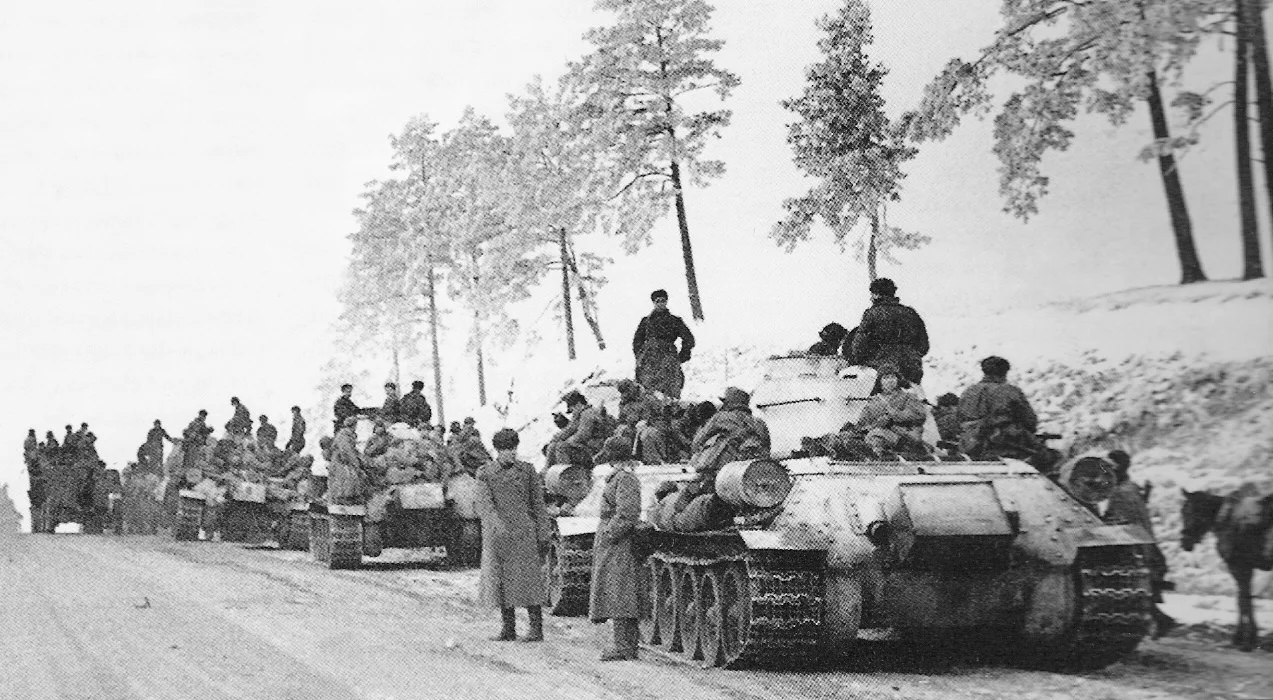

Zhitomir–Berdichev Offensive
It began in fog. On the morning of 24 December 1943, along the highway running west from Kiev, a wall of Soviet artillery opened up and infantry surged forward through winter mist so thick the Germans could not see them coming. For the soldiers of the German XIII and XLII Army Corps, dug in for what they hoped would be a quiet holiday, the suddenness and fury of the attack was a shock. Within hours the front was breaking. This was the Zhitomir–Berdichev offensive, and over the next three weeks it would sweep across the black-earth country of west-central Ukraine, liberating towns that had endured two and a half years of occupation, including a city whose Jewish community had already been destroyed: Berdychiv.
The Overhanging Bridgehead
The stage had been set weeks earlier. After the Soviet capture of Kiev late in 1943, the 1st Ukrainian Front under General Nikolai Vatutin held a large bridgehead on the right bank of the Dnieper, a position that hung over the German forces to the southwest like a threat. Field Marshal Erich von Manstein, commanding Army Group South, threw his 1st and 4th Panzer Armies into a series of counterattacks to shave down that bridgehead and, if possible, retake Kiev. For three weeks his panzers carved out loosely held pockets and inflicted heavy losses on the Red Army. But the Soviets had reserves in depth, and Manstein did not. His counteroffensive stalled, the German bid to recapture Kiev failed, and Vatutin was left holding the ground he needed for a blow of his own.
The Breakthrough
Vatutin's offensive fell on the most sensitive point of Army Group South, its northern flank, the hinge connecting it to the roads leading home to Germany. Three armies led the assault along the Zhitomir-Kiev highway and the Fastov-Kazatin railway: the 1st Guards Army under Andrei Grechko, the 18th under Konstantin Leselidze, and the 38th under Kirill Moskalenko. Fighting alongside them was the 1st Czechoslovak Brigade, exiles battling toward a homeland of their own. When the scale of the disaster became clear, Manstein rushed back to his headquarters at Vinnytsia and began pulling the panzer divisions of General Hermann Balck's corps out of the line to swing south and strike the Soviet spearhead in the flank. He was already too late. The breakthrough was made, and the Soviets were pouring through the gap and exploiting it faster than the Germans could react.
Towns Set Free
Through January 1944 the 1st Ukrainian Front rolled southwest. Berdychiv, occupied since July 1941, was taken on 5 January. The advance pressed on toward Vinnytsia and Zhmerynka before German resistance along the Southern Bug finally checked it, and by February the front had steadied southwest of Berdychiv. When the fighting moved on, the Soviets had driven forward between eighty and two hundred kilometers, clearing German forces from almost all of the Kiev and Zhytomyr regions and from parts of the Vinnytsia and Rovno regions. For the civilians left in these towns, many of whom had lived under occupation for nearly a thousand days, the arrival of the Red Army meant the end of one of the darkest chapters their communities had ever known, whatever hardships still lay ahead.
The Cost and the Consequence
The blow left Army Group South badly weakened. Eight German divisions were destroyed outright or cut to half strength; reserve infantry divisions were disbanded, and battered formations were pulled from the line and sent to Poland to rebuild. To plug the holes, the German command had to rush a dozen divisions of the 1st Panzer Army up from southern Ukraine, spending reserves it could not spare and draining troops from as far away as Western Europe, Romania, Hungary, and Yugoslavia. That exhaustion mattered. By hanging the 1st Ukrainian Front over the enemy's northern flank, the offensive helped set the trap for the Korsun–Cherkassy operation that followed, another pocket, another encirclement, in a winter of relentless Soviet advance across the Ukrainian plain.
From the Air
The offensive swept across west-central Ukraine; the city of Berdychiv, a key objective taken on 5 January 1944, lies at 49.90°N, 28.57°E. From cruising altitude the terrain reads as a vast patchwork of farmland threaded by the Teteriv and Southern Bug rivers, with Zhytomyr to the north and Vinnytsia to the south. The nearest airports are Zhytomyr (UKKV) and Vinnytsia/Havryshivka (UKWW).
Nearby Stories
- Serhiy Pavlovych Korolyov Museum of Cosmonautics 17 km away
- Werwolf (Wehrmacht Headquarters) 31 km away
- Radomysl Castle 42 km away
- Arboretum Oleksandriya 64 km away
- Sofiyivka Park 118 km away
- Olyka Castle 178 km away
- Chernivtsi 214 km away
- Holy Trinity Orthodox Cathedral, Lutsk 223 km away